


A basketball jersey may look simple when a player wears it on the court, but producing a professional custom basketball jersey involves far more than choosing a color and printing a logo.
Behind every finished jersey is a manufacturing process that combines design development, fabric selection, pattern making, sizing, printing, cutting, stitching, quality control, finishing, and packaging. For sports brands, basketball teams, academies, schools, and retailers, understanding this process makes it easier to communicate with a manufacturer and avoid expensive mistakes.
Whether you are ordering uniforms for a basketball team or developing your own sportswear collection, the journey usually starts with one thing: a sketch.
This article takes you through the complete journey of a custom basketball jersey—from the first design concept to the moment the finished jersey reaches the basketball court.
1. The Journey Starts With a Basketball Jersey Idea
Before fabric is cut or a single stitch is made, the manufacturer needs to understand what the customer actually wants.
The starting point can be very different depending on the project.
A professional sports brand might provide a complete technical design. A basketball team might send a basic drawing. A startup brand might only have a logo and a few reference pictures.
The manufacturer then turns that idea into a practical production plan.
A typical custom basketball jersey project may include:
- Jersey design
- Team colors
- Brand logo
- Player numbers
- Player names
- Fabric selection
- Size specifications
- Printing method
- Neck design
- Armhole design
- Side panels
- Labels
- Packaging requirements
This stage is important because mistakes made during design can become expensive once production begins.
For example, changing a logo after fabric has already been printed can mean reprinting the panels. Changing measurements after cutting can mean wasting fabric. That’s why professional manufacturers spend time reviewing the specifications before starting bulk production.
2. Understanding the Customer’s Requirements
Once the initial concept is received, the manufacturer reviews the requirements.
This is where the sketch starts becoming a real product.
A manufacturer may need answers to questions such as:
- What type of basketball jersey is required?
- Is it for a team or a sportswear brand?
- How many pieces are needed?
- What sizes are required?
- What fabric should be used?
- Is the design printed or embroidered?
- Does the jersey require player names?
- Does each jersey have a different number?
- Are matching basketball shorts required?
- Are custom labels required?
- Is special packaging required?
For a team order, the customer may need 12 jerseys with different player numbers.
For a sportswear brand, the same design might be produced in several colors and hundreds or thousands of pieces.
That means the manufacturing approach can change depending on the order.
3. Creating the Digital Basketball Jersey Design
A hand-drawn sketch is useful, but it isn’t enough for production.
The design usually needs to be converted into a professional digital artwork or technical design.
The digital version shows the manufacturer exactly how the jersey should look.
It may include:
- Front view
- Back view
- Side view
- Color specifications
- Logo placement
- Number placement
- Name placement
- Patterns
- Trim details
- Branding information
This digital design becomes an important reference throughout production.
For example, if the front of the basketball jersey contains a team logo, the design should specify its exact position and approximate size.
The back may contain:
PLAYER NAME
and
NUMBER 23
The manufacturer needs to know how these elements should appear and where they should be positioned.
4. Choosing the Right Basketball Jersey Fabric
Fabric selection is one of the most important decisions in basketball jersey manufacturing.
Basketball is a high-movement sport. Players run, jump, change direction, defend, and shoot throughout a game. A jersey therefore needs to provide comfort and freedom of movement.
Common performance-oriented fabrics used for basketball jerseys include polyester-based materials and mesh constructions.
The exact fabric depends on the customer’s requirements.
Important characteristics can include:
Breathability
A basketball jersey should allow air to move through the garment so the player remains more comfortable during physical activity.
Lightweight Construction
A heavy garment can feel uncomfortable during intense activity. Lightweight fabrics are commonly preferred for performance sportswear.
Moisture Management
Performance fabrics may be selected to help manage perspiration during activity.
Durability
Basketball jerseys need to withstand repeated use and washing, especially when they are used as team uniforms.
Color Stability
The fabric needs to maintain its appearance through production and regular use.
A manufacturer should help the customer select a fabric based on the intended application rather than simply choosing the cheapest option.
5. Choosing the Right GSM
Another specification buyers may encounter during manufacturing is GSM, which stands for grams per square meter.
GSM indicates the weight of the fabric.
A lower GSM fabric can generally feel lighter, while a higher GSM fabric can feel heavier or more substantial. However, GSM alone does not determine whether a fabric is better.
Two fabrics with similar GSM can feel very different because their construction, fiber characteristics, and finishing may differ.
For basketball jerseys, the objective is usually to find a balance between:
- Weight
- Breathability
- Durability
- Comfort
- Appearance
- Intended use
This is why requesting a fabric sample before bulk production can be useful.
6. Creating the Pattern
Once the design and fabric specifications are established, the next step is pattern development.
The pattern is essentially the blueprint used to cut the fabric.
It determines the shape and dimensions of the different sections of the jersey.
A basketball jersey may contain pattern pieces for:
- Front body
- Back body
- Neck
- Armholes
- Side panels
- Additional design panels
The pattern needs to account for the intended fit.
A modern basketball jersey might have a relaxed athletic fit, while another design could be more fitted.
The manufacturer also needs to consider the relationship between different sizes.
A small, medium, large, and XL jersey should not simply be created by randomly increasing measurements. Professional pattern grading is used to create size variations while maintaining the intended proportions.
7. Size Development and Grading
Basketball teams often require multiple sizes.
For example:
- Youth sizes
- Small
- Medium
- Large
- XL
- XXL
- Custom sizes
The manufacturer needs to establish a measurement chart before production.
Measurements can include:
- Chest width
- Body length
- Shoulder width
- Armhole
- Neck opening
- Bottom width
For brands, the size chart is particularly important because inconsistent sizing can result in customer complaints and returns.
A good manufacturer should therefore confirm the measurement specifications before cutting bulk fabric.
8. Creating a Sample Basketball Jersey
One of the most important steps before bulk manufacturing is sample development.
The sample is the first physical version of the design.
It allows the customer to evaluate the actual product rather than relying only on a digital image.
The sample can reveal problems that aren’t obvious on a computer screen.
For example:
- The jersey may be too loose.
- The armholes may need adjustment.
- The logo may appear too large.
- The colors may look different on fabric.
- The neckline may need modification.
- The fabric may not feel right.
- The player number may need repositioning.
This is exactly why sample approval is so important.
A digital design can look perfect while the physical garment still needs changes.
9. Reviewing the Basketball Jersey Sample
After the sample is produced, the customer should carefully inspect it.
A useful sample review should look at several areas.
Fit
Does the jersey fit as expected?
Fabric
Does the fabric feel appropriate for basketball?
Colors
Do the colors match the approved design?
Printing
Are logos, numbers, names, and graphics sharp?
Stitching
Are seams clean and secure?
Neckline
Does the neckline have the correct shape and construction?
Armholes
Are the armholes comfortable and symmetrical?
Overall Appearance
Does the physical jersey match the original concept?
If something needs to be changed, the manufacturer can adjust the pattern, artwork, materials, or construction before bulk production.
10. Choosing the Basketball Jersey Printing Method
The artwork is only part of the process. The manufacturer also needs to determine how the design will be applied to the jersey.
Different designs may require different printing techniques.
For many custom basketball jerseys, sublimation printing is particularly useful because it can support detailed, full-color designs.
Other printing methods may also be appropriate depending on the artwork and requirements.
The choice depends on factors such as:
- Design complexity
- Number of colors
- Fabric
- Quantity
- Intended appearance
- Durability requirements
- Production method
The customer should not choose a printing method simply because it sounds impressive. The method should match the fabric and design.
11. Sublimation Basketball Jerseys
Sublimation is widely used in custom sportswear because it can create detailed designs across the fabric.
Instead of simply placing a thick layer of ink on top of the finished garment, sublimation involves transferring the design into suitable synthetic fabric through heat.
This makes it possible to create:
- Gradients
- Detailed patterns
- Multiple colors
- Team graphics
- Geometric designs
- All-over prints
For sports brands that want highly customized basketball jerseys, this can provide considerable design flexibility.
However, sublimation works best with appropriate synthetic fabrics, so fabric selection still comes first.
12. Preparing the Artwork for Production
Before printing, the artwork needs to be prepared correctly.
A manufacturer may check:
- Logo quality
- Image resolution
- Color specifications
- Number placement
- Name placement
- Pattern alignment
- Front and back artwork
- Bleed areas
- Print dimensions
Low-resolution artwork can create problems during production.
For example, if a customer sends a small blurry logo and expects it to appear sharp on a basketball jersey, the manufacturer may need a higher-quality version.
Vector artwork is often useful for logos because it can be scaled without losing quality.
13. Fabric Inspection Before Cutting
Before fabric enters the cutting process, it should be checked.
Fabric inspection can help identify issues such as:
- Stains
- Holes
- Uneven coloration
- Printing defects
- Fabric damage
- Width inconsistencies
This step matters because once the fabric has been cut into individual pieces, fixing a fabric problem becomes much more difficult.
Quality control should therefore begin before sewing.
14. Cutting the Basketball Jersey Fabric
After the fabric is approved, the cutting process begins.
The digital pattern is used to determine the required shapes and dimensions.
The fabric may be layered before cutting multiple pieces.
Accuracy is extremely important.
If the cutting is inaccurate, the final jersey can have problems with:
- Symmetry
- Measurements
- Pattern alignment
- Side panels
- Neckline
- Armholes
For printed basketball jerseys, alignment becomes even more important because the design needs to match across different sections.
15. Organizing the Cut Pieces
After cutting, the individual pieces need to be organized.
This may sound simple, but it is an important production step.
A large order can contain thousands of individual pieces.
The manufacturer needs to keep the pieces organized according to:
- Style
- Color
- Size
- Production batch
- Design
- Front/back panels
Poor organization can lead to mixed sizes, incorrect colors, or missing pieces during sewing.
Good production management reduces these mistakes.
16. Sewing the Basketball Jersey
Now the basketball jersey starts to look like an actual garment.
The cut panels are assembled using industrial sewing equipment.
The sewing sequence can vary depending on the construction, but it generally involves joining the major garment sections before completing details.
The manufacturer pays attention to:
- Seam strength
- Stitch consistency
- Panel alignment
- Neckline construction
- Armhole finishing
- Side seams
- Bottom finishing
A professional jersey should have clean and consistent stitching.
Loose threads, uneven seams, skipped stitches, or poorly aligned panels can reduce the quality of the finished product.
17. Adding Names and Numbers
If the basketball jerseys are being made for a team, individual player names and numbers may need to be added.
This introduces another level of production complexity.
For example:
JAMES — 23
WILLIAMS — 11
MILLER — 7
Each jersey may require different artwork or personalization.
The manufacturer must ensure that the correct name and number are applied to the correct jersey size and team order.
For large team orders, accurate production records are essential.
18. Adding Logos and Branding
Sports brands may require more than team names and numbers.
A custom basketball jersey can include:
- Brand logos
- Team logos
- Sponsor logos
- Woven labels
- Printed labels
- Neck labels
- Size labels
- Care labels
Branding should be planned before production begins.
If a sportswear brand is launching a new collection, custom labels can help create a more professional retail product.
The location of each branding element should be included in the production specifications.
19. Checking the Finished Basketball Jersey
Once the jersey has been assembled, quality control begins again.
The finished product should be inspected for:
Stitching
Are the seams secure and clean?
Printing
Are graphics sharp and correctly positioned?
Sizing
Does the finished garment match the approved measurements?
Color
Does the garment match the approved design?
Construction
Are the neckline, armholes, and panels properly finished?
Appearance
Does the final jersey look like the approved sample?
Quality control should not be treated as a final formality.
It is one of the most important stages in preventing defective products from reaching customers.
20. Thread Trimming and Finishing
After quality inspection, the jersey goes through finishing.
Loose threads are trimmed and the garment is cleaned up.
The jersey may then be pressed or finished to improve its appearance.
The objective is to make sure the product looks presentable when it reaches the customer.
A basketball jersey should not arrive with:
- Loose threads
- Fabric debris
- Unfinished seams
- Packaging dust
- Obvious manufacturing defects
Small finishing details can make a major difference to the perceived quality of the product.
21. Final Measurement Check
For professional production, selected finished garments may be measured again.
This helps verify that production remains within the approved measurement tolerances.
For example, manufacturers may check:
- Chest
- Length
- Shoulder
- Armhole
- Bottom width
Exact tolerances depend on the product and buyer’s specifications.
This is especially important for brands that need consistent sizing across large production runs.
22. Folding and Packaging
Once the basketball jerseys pass inspection, they are prepared for packaging.
Packaging depends on the customer’s requirements.
Options can include:
- Individual poly bags
- Custom packaging
- Size stickers
- Barcode labels
- Hang tags
- Custom boxes
A sportswear brand may want branded packaging to create a consistent customer experience.
A basketball team may simply require individual packaging organized by player.
The packaging plan should ideally be confirmed before production starts.
23. Preparing the Order for Shipment
Before shipment, the manufacturer checks the final order.
The team may verify:
- Total quantity
- Sizes
- Colors
- Styles
- Player names
- Player numbers
- Packaging
- Carton quantities
- Shipping documents
For international orders, documentation and shipping arrangements also need to be handled according to the agreed terms.
The finished basketball jerseys are then packed into cartons for delivery.
24. From Factory to Basketball Court
This is where the manufacturing journey comes full circle.
The process started with a sketch.
It moved through:
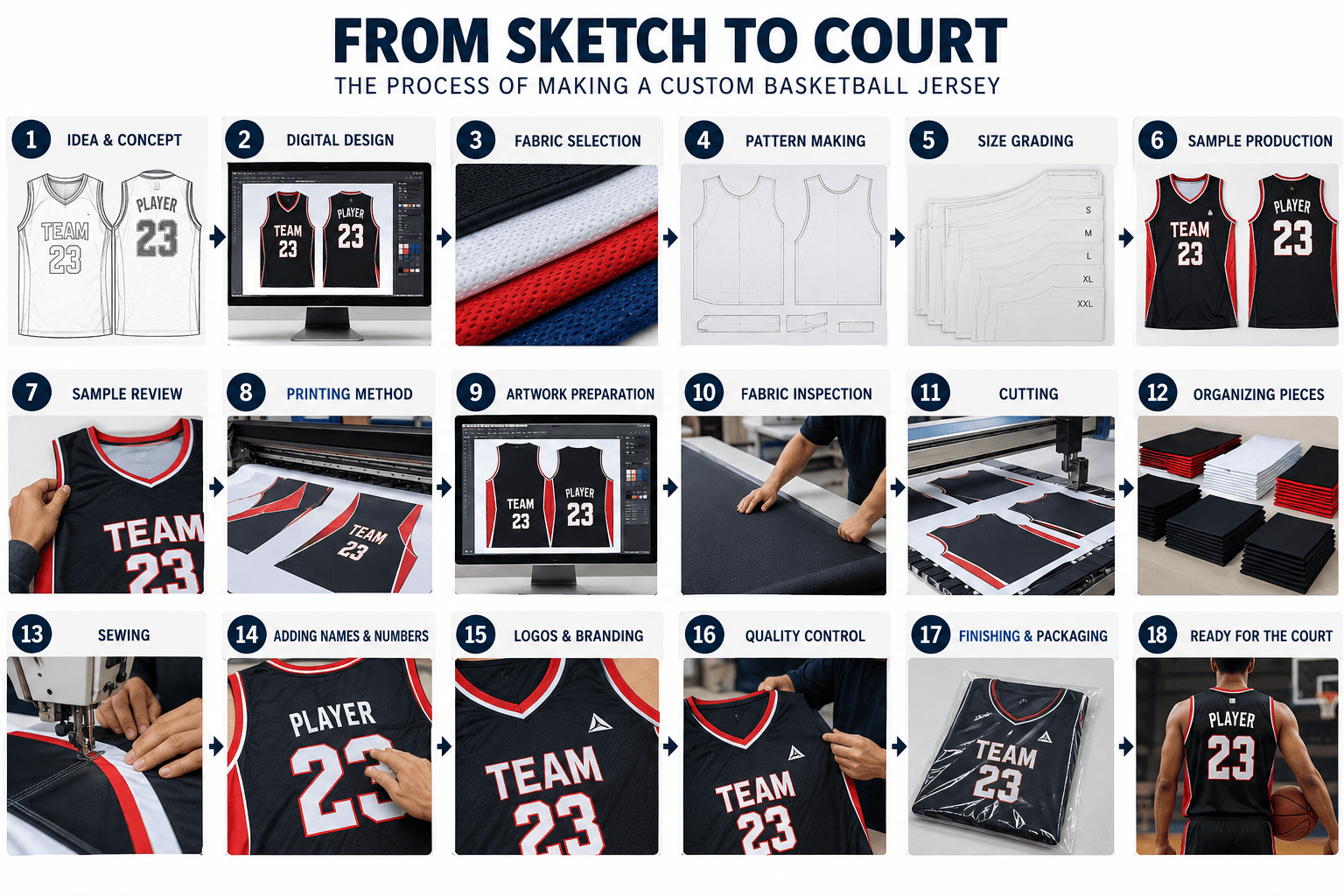
Idea → Design → Fabric → Pattern → Sample → Printing → Cutting → Sewing → Branding → Quality Control → Packaging → Shipment
Eventually, the finished basketball jersey arrives with the team or brand.
A player puts it on.
The design that originally existed as an idea on a screen or piece of paper is now being worn on an actual basketball court.
That’s the real transformation behind custom sportswear manufacturing.
25. How Long Does It Take to Make a Custom Basketball Jersey?
Production time varies depending on the project.
There isn’t one universal production timeline for every manufacturer.
Factors that can affect the timeline include:
- Order quantity
- Design complexity
- Sample requirements
- Fabric availability
- Printing method
- Number of colors
- Customization
- Labels
- Packaging
- Quality control
- Shipping method
A simple team order may be very different from a large private-label collection.
That’s why buyers should discuss production schedules with their manufacturer before placing a bulk order.
26. What Is the MOQ for Custom Basketball Jerseys?
MOQ for Custom Basketball Jerseys
MOQ means Minimum Order Quantity.
Different manufacturers have different MOQ requirements.
Some manufacturers focus on large-scale production, while others offer lower MOQ options for startups, teams, and smaller brands.
A buyer should ask about MOQ before spending time finalizing production.
For example, a startup may want 30 or 50 pieces, while an established sportswear company may require several hundred or thousands.
Finding a manufacturer whose MOQ matches your business model can make the production process much easier.
27. Custom Basketball Jerseys for Sportswear Brands
Basketball jerseys aren’t only produced for teams.
They are also an important product category for sportswear brands.
A brand may create basketball jerseys as part of a larger collection containing:
- Basketball shorts
- Training shirts
- Hoodies
- Warm-up jackets
- Compression tops
- Tracksuits
- Accessories
For a private-label brand, manufacturing can involve additional requirements such as:
- Custom labels
- Hang tags
- Packaging
- Brand-specific sizing
- Custom colors
- Seasonal collections
The manufacturer therefore becomes more than just a sewing supplier.
The manufacturer becomes part of the product development process.
28. Why Sample Approval Matters for Brands
Imagine ordering 500 basketball jerseys and discovering after production that the neckline is wrong.
At that point, the problem becomes expensive.
This is why sample approval is one of the most important stages for brands.
A sample allows the buyer to evaluate:
Design + Fabric + Fit + Printing + Construction + Branding
before committing to bulk production.
For new brands especially, skipping the sample stage to save a small amount of money can be a bad decision.
The cost of correcting a bulk-production mistake can be much higher.
29. Common Basketball Jersey Manufacturing Mistakes
Several mistakes can create unnecessary problems.
Mistake 1: Choosing Fabric Only by Price
The cheapest fabric isn’t automatically the best option.
Mistake 2: Skipping the Sample
This removes an important opportunity to identify problems.
Mistake 3: Sending Poor Artwork
Low-quality logos can create poor printing results.
Mistake 4: Not Confirming Measurements
Different manufacturers may interpret sizes differently.
Mistake 5: Ignoring MOQ
A manufacturer may not be suitable if the required order quantity is below its minimum.
Mistake 6: Not Confirming Packaging
Brands may receive products packaged differently from what they expected.
Mistake 7: Changing the Design Too Late
Late changes can cause delays and additional costs.
Mistake 8: Choosing a Manufacturer Without Checking Quality
A professional-looking website doesn’t automatically guarantee manufacturing quality.
Samples, communication, specifications, and production capabilities should all be evaluated.
30. How to Choose a Basketball Jersey Manufacturer
Choosing the right manufacturer is one of the most important decisions in the entire process.
Don’t select a manufacturer simply because it offers the lowest price.
Look at:
Manufacturing Experience
Does the manufacturer actually have experience producing sportswear?
Customization
Can they manufacture your specific design?
Fabric Options
Can they offer appropriate materials for the product?
Sampling
Can they produce a physical sample before bulk production?
MOQ
Does their MOQ fit your requirements?
Quality Control
Do they have a defined inspection process?
Branding
Can they produce custom labels, packaging, and other branding requirements?
Communication
Can they clearly understand your specifications?
Production Capacity
Can they handle your required quantity without sacrificing quality?
The cheapest supplier can become the most expensive supplier if poor quality results in rejected products.
31. Why Sialkot Is Relevant to Sportswear Manufacturing
Sialkot, Pakistan, is widely associated with sports manufacturing and exports.
The city’s manufacturing ecosystem includes businesses involved in different sports-related products and equipment.
For buyers looking for custom sportswear, working with a manufacturer in a major production hub can provide access to established manufacturing capabilities and related supply chains.
For a basketball jersey buyer, however, the location alone shouldn’t be the deciding factor.
The important question is whether the individual manufacturer can actually deliver the required:
Quality + Design + MOQ + Production + Branding + Delivery
32. The Future of Custom Basketball Jersey Design
Basketball jersey design continues to evolve.
Sportswear brands increasingly experiment with:
- Bold graphics
- Minimalist designs
- Gradient effects
- Retro-inspired aesthetics
- Oversized typography
- Custom patterns
- Team-specific identity
- Lifestyle-inspired basketball apparel
The line between performance sportswear and fashion is also becoming less rigid.
A basketball jersey can be worn on the court, at training sessions, at events, or as part of casual streetwear.
This creates opportunities for brands to design basketball products that appeal beyond traditional team uniforms.
33. Why Customization Matters
A standard basketball jersey can identify a team.
A custom basketball jersey can communicate its identity.
Colors can represent a city or organization.
A logo can represent a brand.
A number can identify a player.
A unique pattern can make a team recognizable.
For sportswear brands, customization also creates differentiation.
Instead of selling another generic jersey, a brand can create a product that has its own visual identity.
That is one of the biggest advantages of custom manufacturing.
34. The Complete Custom Basketball Jersey Manufacturing Process
To summarize the entire journey:
Step 1 — Concept
The customer develops the idea.
Step 2 — Design
The sketch is converted into digital artwork.
Step 3 — Specifications
Fabric, colors, sizing, printing, branding, and construction are confirmed.
Step 4 — Pattern
The technical pattern is created.
Step 5 — Sample
A physical basketball jersey is manufactured.
Step 6 — Approval
The customer reviews and approves the sample.
Step 7 — Fabric Preparation
The required fabric is inspected and prepared.
Step 8 — Printing
The approved artwork is applied using the selected method.
Step 9 — Cutting
Fabric panels are cut according to the approved pattern.
Step 10 — Sewing
The panels are assembled into the basketball jersey.
Step 11 — Customization
Names, numbers, logos, and labels are added as required.
Step 12 — Quality Control
Finished jerseys are inspected.
Step 13 — Finishing
Loose threads are removed and garments are prepared.
Step 14 — Packaging
The jerseys are folded and packaged.
Step 15 — Shipping
The completed order is prepared for delivery.
Step 16 — Court
The finished basketball jersey reaches the player or customer.
35. Final Thoughts
A custom basketball jersey is the result of many individual manufacturing decisions.
What starts as a simple sketch has to become a technically accurate product that can be manufactured consistently.
The success of the final jersey depends on getting the details right throughout the process:
Good design.
Suitable fabric.
Accurate patterns.
Reliable printing.
Precise cutting.
Strong stitching.
Consistent sizing.
Effective quality control.
Professional finishing.
For teams, the result is a uniform that represents their identity.
For sportswear brands, it can become a product that customers recognize and buy.
And for manufacturers, the challenge is turning the customer’s concept into a consistent, production-ready garment.
At Mamoon Wear, custom sportswear manufacturing can be developed around your design requirements, including custom basketball jerseys, team uniforms, branding, colors, printing, labels, and packaging.
If you are developing a new basketball jersey collection or need custom basketball jerseys for your team or business, the process should begin with clear specifications, an approved design, and a manufacturer capable of turning that concept into a finished product.
From the first sketch to the final game, every detail matters.