



Custom activewear development is not the same as slapping a logo on a blank garment. It means controlling fabric composition, GSM, stitch construction, fit, color, and branding from the ground up. For brand founders evaluating manufacturers, understanding what happens on the factory floor after you hit send on that first email is what separates a smooth launch from a costly one. This guide walks through the process from the manufacturer’s side: what we need from you, how fabric and construction decisions shape your product, and what the timeline looks like from tech pack to bulk delivery.
What “Custom” Actually Means in Activewear Manufacturing
Custom manufacturing means every specification is yours to define. The factory builds your garment from raw fabric based on your tech pack, not from a catalog of pre-made blanks. That distinction matters because it determines whether you own a product your competitors cannot replicate or whether you are reselling the same stock garment as fifty other brands.
In activewear specifically, “custom” covers six layers of decisions: fabric composition and weight, knit structure, pattern and fit, construction method (cut-and-sew or seamless), decoration (sublimation, screen print, embroidery, silicone logos), and private label branding (neck labels, woven tags, hang tags, packaging). A factory that calls itself a custom manufacturer should be able to answer technical questions about each of these layers without deflecting to vague reassurances about “premium quality.”
If a supplier can only offer pre-made blanks with your logo heat-pressed on, that is private label branding on a stock garment, not custom development. Both models have their place, but you should know which one you are paying for. True custom development gives you control over squat-proof opacity, compression level, seam placement, and how the garment feels in your customer’s hands. For a deeper look at how factories evaluate your project, see our activewear manufacturing guide for startups.
Tech Pack Essentials Before You Contact a Factory

Your tech pack is the single document that tells the factory exactly what to build. It is the difference between receiving a quote in 24 hours and spending two weeks clarifying missing details over email. A complete tech pack eliminates ambiguity, and ambiguity is what drives up sampling costs and delays.
Here is what a production-ready tech pack should include:
- Flat sketches (front and back) showing seam lines, panel breaks, and construction details
- Points of Measurement (POMs) with target values for your base size, including waist, hip, inseam, rise, and any garment-specific measurements
- Fabric specification: composition (e.g., 80% Nylon / 20% Spandex), GSM range, knit type (interlock, single jersey, ribbed), and stretch direction (2-way or 4-way)
- Color callouts using Pantone TCX codes, not verbal descriptions like “navy blue”
- Stitch and seam construction: flatlock, coverstitch, overlock, or bonded seams at each joining point
- Trim and branding details: neck label type (woven, heat-transfer, tagless), hem tags, drawcord specs, and packaging requirements
- Size range and grade rules: your intended size run (XS to 3XL, for example) and any size-specific construction notes
If you do not have a full tech pack yet, that is not a dealbreaker. An OEM team can develop one from your reference photos, sketches, or physical samples. But coming in with measurements, fabric preferences, and color codes already defined will compress your timeline significantly and give you a more accurate quote on the first pass.
One common mistake first-time founders make is specifying a fabric by feel alone (“I want something buttery soft and squat-proof”) without giving the factory composition and GSM targets. The factory cannot source a fabric from an adjective. Tell us “80/20 nylon-spandex interlock, 250 to 280 GSM, 4-way stretch” and we can source it. Tell us “buttery soft” and we are guessing.
Fabric Selection: Nylon-Spandex, Recycled Poly, and Knits

Your fabric choice determines performance, handfeel, cost, and durability more than any other specification. In activewear, three fabric families dominate: nylon-spandex blends, recycled polyester blends, and engineered seamless knits. Each serves a different product tier and customer expectation.
Nylon-Spandex Blends
Nylon-spandex (typically 75/25 to 80/20) is the gold standard for premium leggings, sports bras, and compression wear. Nylon delivers a smooth, supple handfeel and strong abrasion resistance, while spandex provides the stretch and recovery that keeps a garment from bagging out after a workout. For squat-proof leggings, you generally want 220 to 280 GSM in an interlock knit. Lighter weights (160 to 210 GSM) work for training tops and shorts where breathability matters more than opacity.
A critical point: spandex percentage alone does not predict compression. A fabric with 25% spandex is not automatically more supportive than one with 20%. Perceived compression depends on GSM, knit density, yarn tension, and how the spandex is distributed in the construction. Define your expected stretch direction, extension range, and end use rather than just asking for “high stretch.”
Recycled Polyester
Recycled polyester (rPET) performs comparably to virgin polyester in terms of stability, durability, and color clarity. It is a legitimate sustainability choice, not just a marketing claim, but the certification chain matters. The Global Recycled Standard (GRS) requires at least 20% recycled content for business-to-business claims and 50% for consumer-facing labeling. If your brand plans to market recycled content on hang tags or product pages, your factory must supply GRS Transaction Certificates with each shipment. Without that documentation, your claim is unsupported and potentially non-compliant.
Recycled polyester blends well with spandex for leggings, tops, and outer layers. Specify recycled polyester with the same technical rigor you would for virgin fabric: GSM, knit type, stretch direction, and finish. Do not assume that “recycled” means lower quality. A well-constructed rPET knit can match or exceed a poorly constructed virgin polyester knit in physical testing.
Seamless Knits and “Buttery Soft” Fabrics
The “buttery soft” feel that dominates premium athleisure usually comes from fine-denier nylon yarns knitted in a high-gauge interlock or ribbed structure. These fabrics are typically 190 to 240 GSM and use nylon-spandex or nylon-polyester-spandex blends. The softness comes from the yarn quality and finishing process, not from a generic fabric category. If you want that signature feel, specify fine-denier nylon with a brushed or sand-washed finish and request physical fabric swatches before committing.
Seamless knits, produced on circular knitting machines, offer engineered rib zones, mesh ventilation, and varying knit densities within a single garment. These are distinct from cut-and-sew fabrics and have their own construction considerations, which we cover in the next section.
Seamless vs. Cut-and-Sew: Construction Choices That Change Fit
The construction method you choose determines your design flexibility, development timeline, and how the garment fits. Neither method is universally better. The right choice depends on what you are building.
Cut-and-Sew Construction
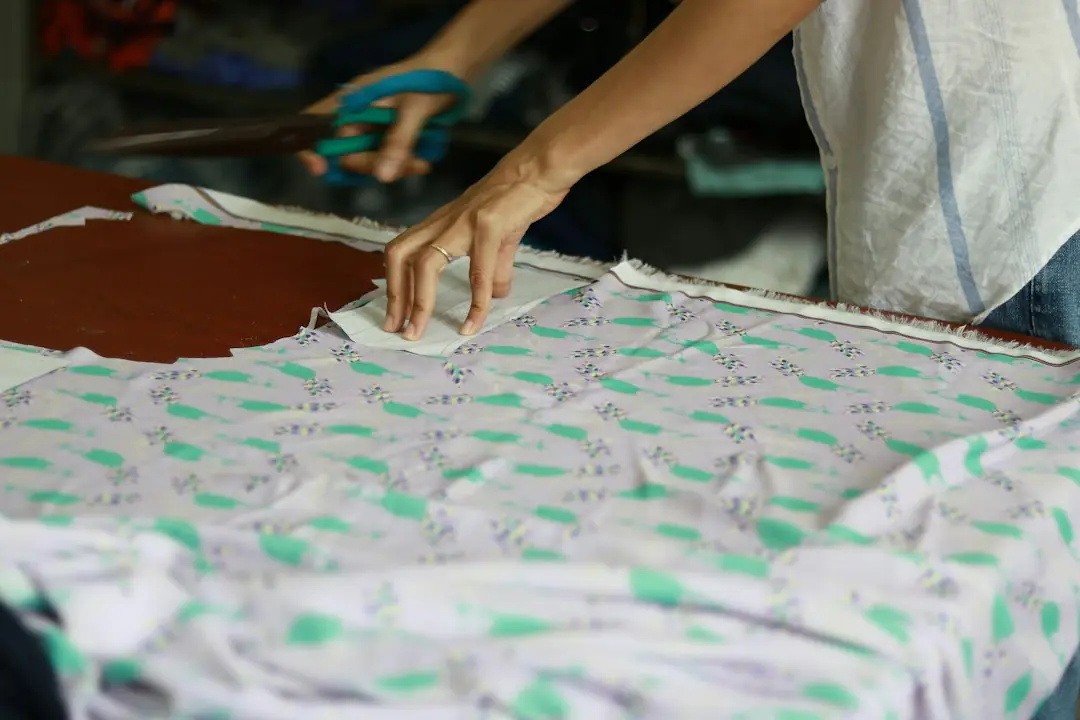
In cut-and-sew production, fabric arrives as a roll. It is spread, cut into pattern panels, and assembled using flatlock, coverstitch, or overlock seams. This method gives you direct control over panel shape, seam placement, waistband structure, pockets, zippers, color blocking, and mixed-fabric construction. If your design calls for a tennis dress with an internal bra, built-in shorts, and a zip pocket, cut-and-sew is the route. It also offers the broadest range of print and decoration options.
The main technical risk is not the seams themselves but poor seam engineering. Incorrect stitch density, thread tension, or stretch ratio can cause puckering, chafing, or restricted movement. A competent factory specifies the correct stitch type and thread for each seam based on the fabric’s stretch characteristics.
Seamless Construction
Seamless activewear is produced on computerized circular knitting machines. Yarn feeds directly into the machine, which builds the garment as a tube with programmed stitch structures. Different zones can have varying density, ribbing, mesh ventilation, and support panels, all knitted into a single piece. This is what creates the engineered look and feel associated with premium seamless leggings and sports bras.
“Seamless” does not mean zero sewing. Most seamless garments still require assembly for straps, gussets, cups, labels, and hems. The term refers to the body being knitted rather than cut from flat panels. Seamless reduces conventional seam bulk and friction, which is why it is popular for next-to-skin compression and yoga wear. However, seamless constrains your design freedom: complex pockets, zipper integration, and multi-fabric color blocking are difficult or impossible on a circular knitting machine.
Revision cycles also differ. In cut-and-sew, a pattern tweak is a pattern tweak. In seamless, a structural change can require reprogramming the knitting machine, which means new sample trials and longer development time.
| Factor | Cut-and-Sew | Seamless |
|---|---|---|
| Design flexibility | High: unlimited panel shapes, pockets, zippers, mixed fabrics | Constrained by knitting program and machine capabilities |
| Seam bulk and chafing | Multiple sewn panel joins; quality depends on seam engineering | Reduced conventional seams; smoother against skin |
| Body-mapped zones | Created through separate panels, mesh inserts, or perforation | Engineered into the knit program (varying density, rib, mesh) |
| Print and decoration | Full range: sublimation, screen print, DTF, embroidery, patches | Limited; depends on yarn and post-knitting process |
| Size grading | Precision individual grading of each pattern piece | High stretch can cover a range, but fit still requires testing |
| Revision process | Pattern and construction adjustments are straightforward | Structural changes require machine reprogramming and new trials |
| Typical best use | Complex designs, color blocking, pocketed garments, team uniforms | Yoga wear, compression leggings, sports bras, sculpting sets |
Sampling, Grading, and the Path to Bulk Production
Development flows through defined stages: pre-production sample, size set approval, and bulk production. Each stage has a specific purpose, and skipping one is how brands end up with inventory that does not fit.
Sample Development
Sample development takes 5 to 7 working days after design and fabric confirmation. The pre-production sample is your opportunity to evaluate fit, stretch recovery, stitch quality, color accuracy, and print or embroidery durability in person. You should measure every critical POM on the sample, not just eyeball it. If the waist is 2 cm off from your tech pack spec, flag it before approving bulk.
At Mamoon Wear, we do not move to bulk production without your sample approval. This is not a courtesy; it is a quality control checkpoint. Once you approve the sample, the spec is locked. Changes after approval mean new samples and extended timelines.
Size Grading from XS to 3XL
Grading is the process of scaling your approved base-size pattern up and down into a full size run using grade rules. These rules are not a uniform enlargement. Human bodies do not grow proportionally, and activewear adds the complication of negative ease, where the garment is intentionally smaller than the body and relies on fabric stretch to close the gap.
Each point of measurement gets its own increment. A legging might grade the waist by 4 cm between sizes, the thigh by 3 cm, and the inseam by just 0.5 cm, because leg length does not scale with girth. Uniform grading, where you add the same increment everywhere, is the single most common fit killer in a size run. It creates a balloon at the waist and a pinch at the cuff on larger sizes.
For extended sizing (2XL and above), a single grade nest may not preserve proportion and support at both ends of the range. Many brands use a second fit block or adjusted grade rules for extended sizes. This is a decision that should be made deliberately during development, not discovered after bulk complaints from customers in larger sizes. If your target range is XS to 3XL, discuss grade rule breaks with your factory before sampling.
Within our 30-piece MOQ per colorway, you can mix multiple sizes in a single run. That means a 30-unit order can include a range of sizes, giving you a true size set to test fit across your range before committing to volume. For more on how low MOQs work in practice, see our sportswear sourcing guide.
Bulk Production Timeline
After sample approval, bulk production runs 12 to 15 working days for standard programs. Larger or more complex orders may extend slightly. The production sequence includes fabric cutting, stitching assembly, printing or embroidery, quality inspection, and packaging. Every garment passes through QC checkpoints for stitching integrity, sizing accuracy, color consistency, and finishing quality before it ships.
Shipping to the USA, UK, Europe, UAE, and Australia is handled via express courier (DHL or FedEx), typically adding 4 to 6 working days for door-to-door delivery. The total timeline from sample approval to goods in your warehouse is roughly 3 to 4 weeks for a standard program.
Getting Your Quote Started
The fastest path to an accurate quote is sending a complete tech pack with fabric specs, color codes, size range, and target quantities. If you are earlier in the process, reference images, sketches, or physical samples also work. Our production team responds with a detailed quote within 24 hours, including unit pricing, MOQ confirmation, sample timeline, and estimated bulk production schedule.
Send your tech pack, design mockup, or reference images through our custom inquiry form or WhatsApp. We will tell you straight whether we can hit your specs, what the realistic timeline looks like, and where your design might need adjustments for production. No pressure, no upsell, just a technical assessment of your project.
Frequently Asked Questions
What is the minimum order quantity for custom activewear production?
Our starting MOQ is 30 pieces per design and colorway, with up to five mixed sizes (such as XS through XL) included in a single run. This lets founders test multiple styles and colorways without tying up thousands of dollars in unsold inventory.
How long does sampling take before bulk production?
Pre-production sample development takes 5 to 7 working days after design and fabric confirmation. Once you approve the sample, bulk production runs 12 to 15 working days for standard programs, followed by 4 to 6 working days for express shipping.
Do I need a complete tech pack to request a quote?
No. A complete tech pack gets you the most accurate quote fastest, but our OEM team can develop specs from your reference photos, sketches, or physical samples. The more detail you provide (fabric composition, GSM, Pantone colors, measurements), the faster and more precise the quote.
What fabric should I choose for squat-proof leggings?
For squat-proof leggings, use an 80/20 or 75/25 nylon-spandex interlock knit at 220 to 280 GSM with 4-way stretch. The combination of nylon’s opacity at higher GSM and spandex’s recovery prevents sheerness during bending and stretching. Lighter weights (160 to 210 GSM) are better for breathable training tops.
Can I grade my activewear from XS to 3XL in one production run?
Yes, but extended sizes (2XL and above) may require adjusted grade rules or a separate fit block. Bodies do not scale proportionally, and activewear relies on negative ease, so uniform grading creates fit problems at both ends of the range. Discuss grade rule breaks with your factory during development.